Repiping
Repiping in Boerne, TX: Whether a Whole-House Pipe Replacement Is Worth Pricing
Most houses in Boerne are too new to need this. If yours is in the older part of town, or your slab has leaked more than once, it is worth pricing properly.
Or call (833) 571-0120 and describe what you are seeing.
Most Boerne homes do not need repiping
This is the one service page on this site that starts by talking most readers out of it.
Boerne went from about 10,500 people in 2010 to 17,850 at the 2020 census, a 70.5 percent increase, and has kept growing since. A city that nearly doubled in a decade has a housing stock weighted heavily towards post-2000 construction, and houses built in that window were plumbed with PEX or modern copper on the supply side and plastic waste lines on the drain side.
Those materials are not near the end of their service lives. If your house was built in the last twenty-five years and you have had one leak, you have had one leak. You do not have a repiping problem, and anyone who tells you otherwise after a single failure is selling rather than diagnosing.
Who this page is actually for
Two groups, and they have almost nothing in common except the word repiping.
The first is the older housing in and around the historic core, where the original cast iron waste lines and galvanized supply lines are now old enough to be failing as a system rather than at one spot. That is what the steady local search volume for cast iron pipe work is really about.
The second is any property, however new, where the same slab has leaked more than once. That is not a material-age problem, and the fix is different. It has its own section below.
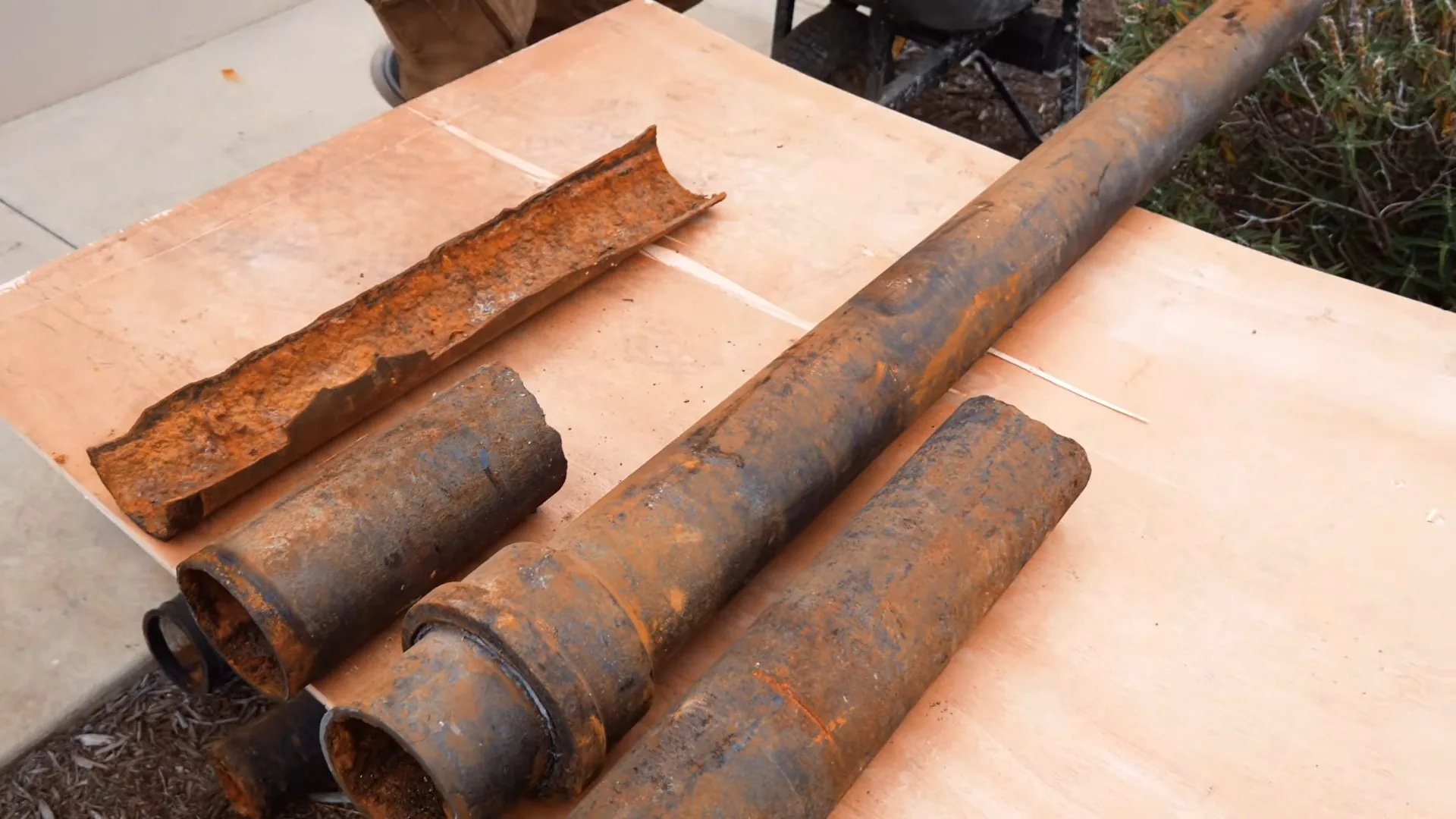
Identifying your pipe material by era and appearance
Before anything else is worth discussing, establish what is actually in the walls. You can get most of the way there yourself in about ten minutes, and it changes the conversation completely.
| Material | Roughly when used | How you recognize it | What it means for you |
|---|---|---|---|
| Cast iron | Drains, into the mid-1970s | Heavy dull gray pipe, often 3 or 4 inches, rings dull when tapped, rusty scaling at joints | Fails from the inside out; replacement is by section or by stack |
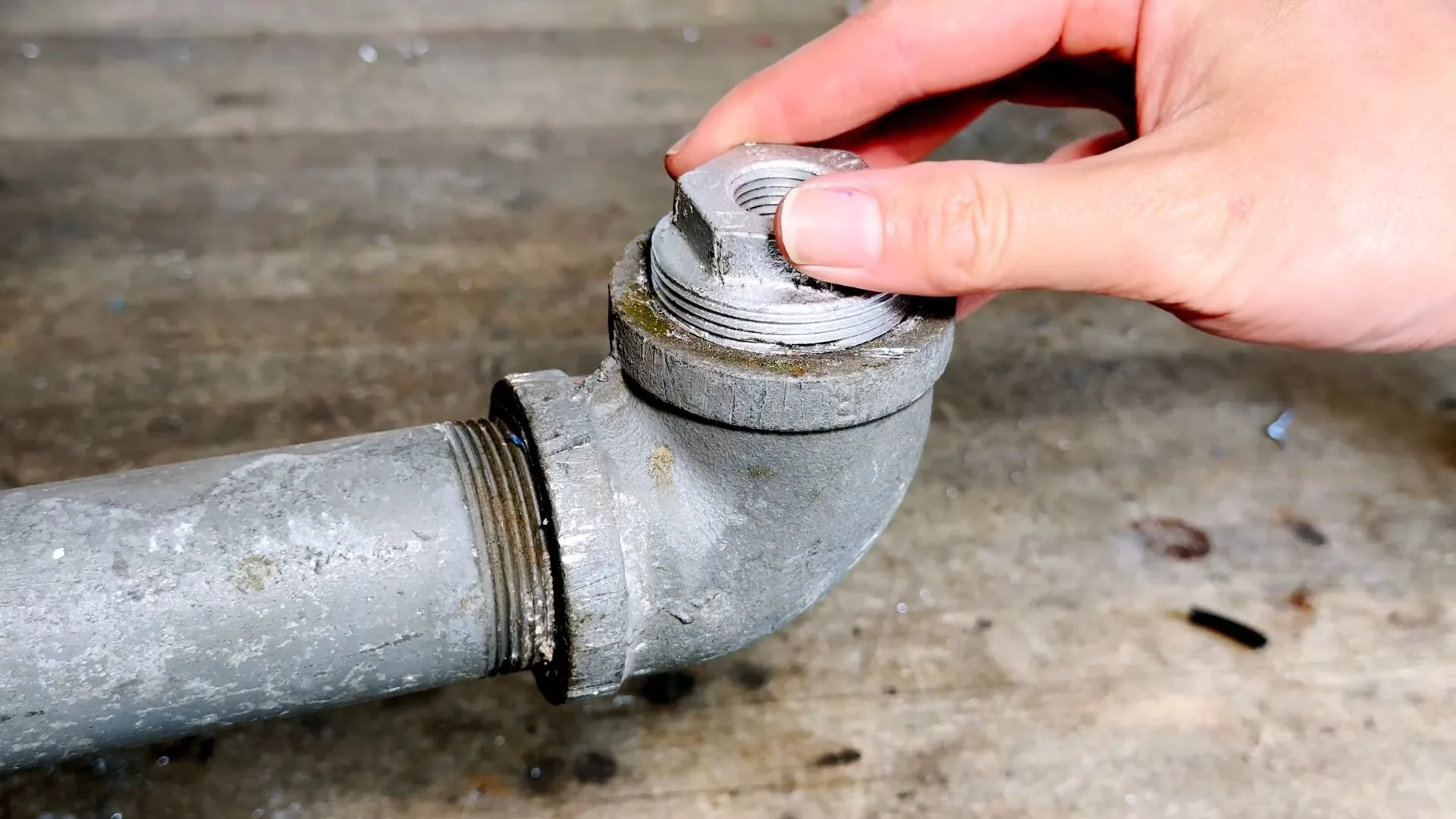
| Galvanized steel | Supply, pre-1960s | Dull silver-gray, threaded joints, magnetic | Narrows internally with corrosion; pressure drops long before it leaks |
| Copper | Supply, 1960s onward | Unmistakable reddish-brown, soldered joints | Long-lived; usually repaired rather than replaced wholesale |
| Polybutylene | Supply, roughly 1978 to 1995 | Dull gray flexible pipe, often with plastic fittings and metal crimp rings | Worth identifying specifically; ask about it if your house is from that window |
| PEX | Supply, 1990s onward and standard now | Flexible plastic tubing, often red and blue, usually from a central manifold | What a repipe installs today, not what it replaces |
| PVC or ABS | Drains, 1970s onward | White or black plastic, glued joints, light to tap | Not a repiping candidate on age alone |
Where to look without opening anything
- Under the kitchen sink and the bathroom vanities, where supply pipe is usually visible before it disappears into the wall.
- At the water heater, where several runs converge and the material is normally exposed.
- In the attic, where in this market a good deal of pipe is routed and where a reroute would eventually go.
- Anywhere a cleanout is accessible, which tells you the drain material rather than the supply material.
- The main shutoff and the meter, which tells you what the service line into the property is.
If you can tell us what you found under the sink and roughly when the house was built, we can usually tell you on the phone whether this is worth a visit.
Call (833) 571-0120Cast iron drains: the real local search
People here search for cast iron pipe work more than for anything else in this category, and it is worth being precise about what that job is, because cast iron fails in a way that is easy to misread.
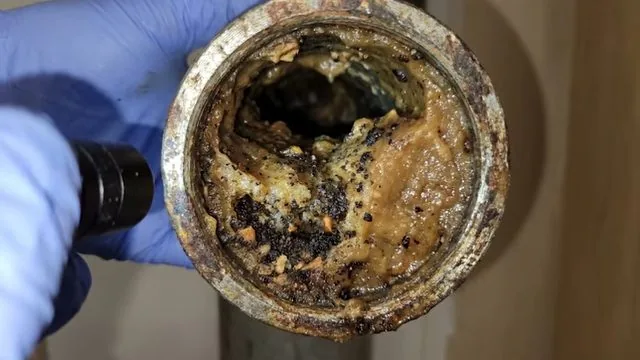
It does not usually fail by springing a leak. It corrodes from the inside, so the bore roughens and narrows, debris catches on the rough surface, and the symptom you notice is a drain that keeps blocking. The scale builds, sections thin, and eventually the bottom of a horizontal run gives way. That means repeated blockages in an older house are a condition report, not a cleaning problem, and no amount of rodding changes what the pipe is.
-
Camera it before costing it
A survey tells you the material, the wall condition, where the thin sections are and how far the damage runs. Without that, any number is a guess.
-
Separate the stack from the laterals
The vertical stack inside the building and the horizontal runs under the slab or out to the main are different jobs with different access, and often only one of them needs doing.
-
Replace by section where the survey allows
If two meters of a run is bad and the rest is sound, that is what gets replaced. Whole-stack replacement is for whole-stack failure.
-
Reinstate properly
New plastic tying into remaining cast iron needs the right couplings and the right support. Unsupported plastic sagging between old cast iron brackets creates the next blockage.
The boundary, because it decides which page you want
This page covers the drain pipework inside the building: the vertical stacks and the branch lines in walls and under floors. Cast iron that has failed under the slab, or out in the yard between the house and the main, is a different job with different access and different equipment. That is replacing the sewer line, or trenchless lining where the run can be rehabilitated without digging it up. If you are not sure which you have, the camera survey answers it before anyone quotes.
When a second slab leak changes the arithmetic
This is the case that has nothing to do with how old your pipes are, and in Boerne it is the more common of the two.
The verified driver of underground leaks here is ground movement rather than pipe age: shallow Hill Country soils over limestone, in a county inside the Hill Country Priority Groundwater Management Area, going through a documented rainfall deficit. Cow Creek Groundwater Conservation District recorded September 2026 rainfall of 0.49 inches against a 3.82 inch historical average. Soil that dries, shrinks, then swells again when the rain finally arrives moves what is buried in it, and a supply line under a slab has nowhere to go.
The consequence is that a house can be fifteen years old, plumbed in perfectly good material, and still be on its third slab leak. Each one is found, the slab is broken, the section is repaired, the slab is patched. The pipe was never the problem and the next leak appears somewhere else along the same run.
The reroute, and when it is the cheaper answer
- Instead of repairing under the slab again, the run is abandoned in place and a new one is routed overhead through the attic and dropped down to the fixtures.
- Nothing is then buried in moving soil, so the failure mode that caused the first three leaks no longer applies to that run.
- No further slab breaking, which is usually the most disruptive and most expensive part of any individual repair.
- It is normally priced against the alternative of one more spot repair plus the odds of another. By the second or third leak on the same line that comparison often stops being close.
- It is not always the answer: a single leak, or leaks on genuinely different runs, usually points at leaks under the slab rather than at rerouting the whole system.
What we will not do is use one slab leak to sell a reroute. One leak is a repair. The reroute conversation starts when a pattern exists, and if you have had only one, we will say so and fix the one.
What a supply repipe actually involves
For the smaller group that does need the supply side replaced, mostly the older galvanized houses, the process is more disruptive than a repair and less disruptive than people fear. The walls do not all come out.
-
Plan the routes first
Where the new runs will go, usually attic-down rather than through the slab, and where a central manifold can sit so each fixture has its own run back to one place.
-
Open only at the access points
Small openings at fixtures, at drops and where runs change direction, rather than stripping walls. The number of openings is the honest thing to ask about up front.
-
Run the new system alongside the old
The existing supply usually keeps working while the new runs go in, which keeps the time without water down to the changeover rather than the whole job.
-
Changeover, pressure test and commission
The new system is tested under pressure before anything is closed up, and the old pipe is isolated and abandoned rather than left connected.
-
Hand the openings over
We make the openings and we do not close them. Patching, finishing and painting is a different trade, and that boundary is stated before the job rather than discovered after it.
On the figure you will have seen
Whole-house repiping carries one of the widest ranges on our cost guide, and the width is real rather than evasive. What moves it is the house: floor area, how many bathrooms, single story or two, whether the attic is accessible, how many openings the routes require, and whether the drain side needs doing at the same time. A single-story three-bathroom house with a walkable attic and a two-story house with a tight roof space are not the same job. The figure is also one of the reasons this page spends its first section telling most readers they do not need it.
Permits, and what to ask before you sign anything
A repipe is substantial work and it is permitted work. Boerne has adopted the 2021 International Plumbing Code, and the City requires contractors to be registered with it to work within the city limits. Permitting and Code Compliance at 447 N. Main Street will tell you what your specific job needs on (830) 248-1529, and that is a call worth making yourself rather than taking a contractor's word for it. You can verify a plumber's license independently through the Texas State Board of Plumbing Examiners.
Questions that separate a quote from an estimate
- Has the system been surveyed, or is this priced from a walk-round? On the drain side, a quote without a camera survey is a guess with a number on it.
- Exactly which runs are included, and which are being left in place? A partial repipe is legitimate, but it should be stated rather than assumed.
- How many openings will be made, and who closes them? If the answer to the second part is nobody, budget for the trade that does.
- Is a permit being pulled, and by whom?
- What happens if the survey finds more than the quote covered? The honest answer is a stated process for re-pricing, not a promise it cannot happen.
- How long will the water be off, as distinct from how long the job takes?
If a single pipe has burst and you want it fixed rather than the house re-plumbed, that is repair of a burst line. If you suspect a leak but cannot see one, start with finding the leak: finding it is a separate job from fixing it, and it should come first.
Repiping questions from Boerne
How do I know if I actually need repiping?
Three things point to it, and one leak is not among them. Material and age: galvanized supply pipe or cast iron drains in a house from before about 1980. A pattern rather than an event: repeated drain blockages in the same older system, or falling pressure at several fixtures at once, or a third leak on the same run. And a survey that shows the condition is general rather than local. If your house is post-2000, which most houses in Boerne are, and you have had a single failure, you almost certainly need that failure repaired and nothing more.
Why do people here search for cast iron pipe work when the city is so new?
Because the city is not uniformly new. The growth since 2000 built out the newer areas, but the older housing in and around the historic core predates plastic drainage, and cast iron waste pipe from that era is now at the end of its life. Those properties are a minority of the housing stock and generate most of the genuine demand in this category. It is also why we would rather ask when your house was built than quote from a search term.
Can you repipe a house without tearing out the walls?
Largely, yes, and the fear of total demolition is the main reason people put this off longer than they should. New supply runs normally go overhead through the attic and drop down to fixtures, so the work needs small openings at fixtures, drops and direction changes rather than stripped walls. The number of openings is the thing to ask about in writing. Drain work is less forgiving, because a vertical stack is where it is, but even there replacement is usually by section guided by a camera survey rather than wholesale.
My slab has leaked twice. Is repiping the answer or is that overkill?
It depends on whether the two leaks were on the same run. Two failures on the same line in a market where the real driver is soil movement over shallow limestone is a pattern, and at that point rerouting the run overhead stops burying pipe in moving ground and is often cheaper than another slab repair plus the odds of a third. Two leaks on genuinely different runs is usually still repair territory. We would want to see where both were before recommending either, and we will not quote a reroute off a single leak.
What does repiping cost in Boerne?
Our cost page carries a wide range for whole-house repiping, and the width reflects real variation rather than caution. Floor area, bathroom count, one story or two, attic access, how many openings the routes need, and whether the drains are being done alongside the supply all move it substantially. A camera survey on the drain side and a walk-through on the supply side are what turn that range into a number for your house. Be wary of a firm figure offered before either has happened.
Do I need a permit, and will it pass inspection afterwards?
Repiping is permitted work inside the city limits, and Boerne also requires the contractor to be registered with the City. The City has adopted the 2021 International Plumbing Code, and Permitting and Code Compliance at 447 N. Main Street will confirm your specific job on (830) 248-1529. Ask who is pulling the permit before work starts, because retrofitting a permit onto finished work that is already closed up is considerably harder than arranging it at the beginning.
Not sure which of those you are?
Tell us roughly when the house was built, what material you can see, and how many leaks you have had. That is usually enough to say over the phone.