Water damage
Water Damage Restoration in Boerne, TX: Removal, Structural Drying and Who to Call for Repairs Afterward
A pipe, a water heater or a supply line has let go and the building is wet. We extract the water and dry the structure back to a measured dry standard. We do not rebuild what has to come out, and we say so before we start.
Or call (833) 571-0120 and describe what you are seeing.
The first hour decides most of the damage
Water that stops moving within an hour is a drying job. Water that runs for four is a rebuilding job. The gap between those two outcomes is almost entirely what happens before anyone arrives.
-
Shut the water off
At the fixture stop if the failure is a supply line or a toilet, at the main stop if you cannot tell where it is coming from. Knowing where your main stop is before you need it is the single most useful thing in this list.
-
Kill power to the affected area if you can do it safely
From a dry position at the panel, not by reaching for a switch or a socket in standing water. If that is not possible from somewhere dry, leave it and tell us when we arrive.
-
Photograph everything before you move it
Wide shots and close ones, including the failed component itself. Insurers ask for the condition before anyone intervened and you cannot recreate it afterwards.
-
Lift what you can and get air moving
Furniture off wet carpet, rugs up, contents off the floor. Open interior doors. Household fans are not drying equipment but they are better than still air.
-
Leave the HVAC alone if sewage is involved
Running the system moves contaminated air through the whole building. Clean water is different and airflow helps. If you are not sure which you have, do not run it.
What we are and are not
We extract water and dry the structure. That means standing water out, air movers and dehumidifiers in, and moisture readings taken daily until the materials reach a dry standard rather than until they feel dry to the hand. When someone searches for water damage restoration services in Boerne, the real need is usually a company that will extract the water and start measured drying. In trade language that stage is water mitigation, and any rebuilding that follows is a separate job.
We do not then rebuild the property. We do not hang new drywall, lay new flooring or repaint, and we do not remediate mold. Where something has to be removed to dry what is behind it, we remove it and tell you plainly what will need putting back, so the rebuild can be quoted by someone who does that work.
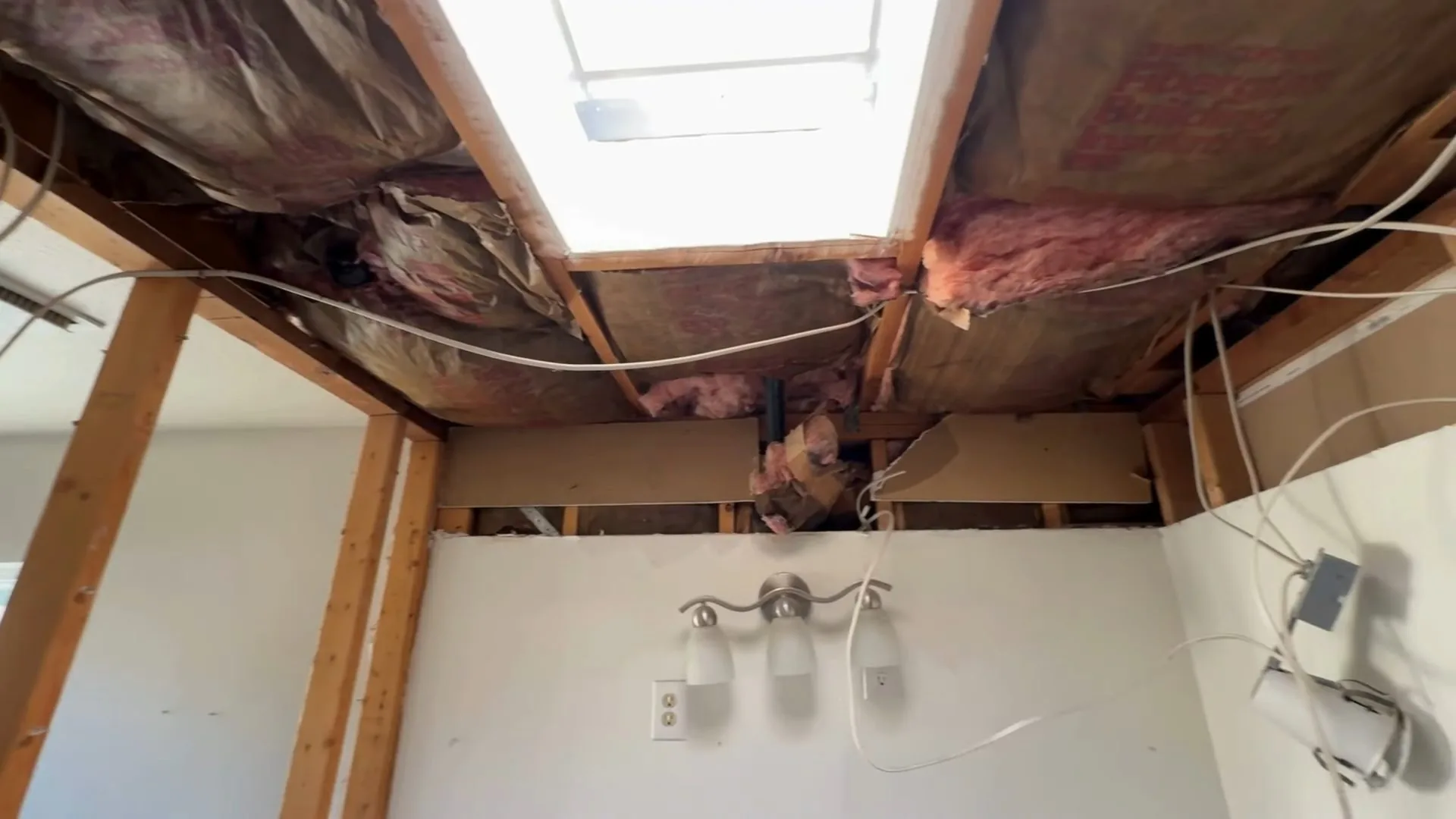
A stained ceiling is nearly always a fixture above it
The most common water damage call we take is not a dramatic burst. It is a brown ring on a ceiling, and the pattern is consistent enough to be a diagnosis in itself. Across 24 inquiries about ceiling and wall damage, fifteen became jobs, and the recurring story barely varies: a bathroom upstairs, a stain appearing in the room below, and a homeowner who has worked out roughly where it is coming from but not what is leaking. For water damage restoration, Boerne callers get the most from a call that says what is wet, how long it has been wet and whether the water was clean.
People described it to us as a leak coming through the ceiling into the dining room, a ceiling that leaked from the bathroom above it, water staining damage on a ceiling, and a kitchen ceiling that was simply wet. Those are four descriptions of one problem.
What is usually above the stain
- A shower pan or its drain connection, where the failure only shows while the shower is actually running.
- A toilet supply line or the seal under the pan, which weeps rather than pours and so stains slowly.
- A bath waste or overflow fitting, often only leaking when the bath is filled past a certain point.
- A water heater in the attic, which in this market is common, and which drains straight through the ceiling below when the tank or the pan drain fails.
- A supply line in the ceiling void, which produces a stain some distance from the actual break because water runs along a joist before it finds a way down.
Two things follow from that. First, a stain is not where the leak is, it is where water found an exit, so finding the source is a separate job from drying and it goes first. That is leak detection, and on an attic installation it often turns into a heater repair once the source is confirmed. Second, a ceiling that is wet is holding weight. Saturated drywall sags and then comes down in sheets, so if a ceiling is bulging or heavy, keep people out from under it.
What drying actually involves
Drying a building is a measured process rather than a matter of leaving fans running until things look better. Materials hold water long after their surfaces feel dry, and a wall that is dry on the face and wet in the cavity is exactly the situation that causes trouble weeks later.
-
Extraction
Standing water comes out first, mechanically. Nothing else on this list is worth starting while there is still water lying on the floor.
-
Reading the building, not guessing at it
Moisture readings establish how far the water traveled, which is usually further than the visible wet patch. Those first readings are the baseline everything later is measured against.
-
Opening up only what has to be opened
Sometimes a cavity cannot be dried through a wall surface and a section has to come out, or a kickboard, or a run of skirting. We take out what is needed to dry what is behind it and no more.
-
Air movers and dehumidification
Air movers lift moisture out of materials into the air. Dehumidifiers take it out of the air. Both together are drying; either one alone mostly moves the problem around.
-
Containment where it helps
Sealing the wet area concentrates the equipment on the part of the building that needs it, instead of trying to dehumidify the whole property.
-
Daily readings to a dry standard
Readings are repeated until the affected materials match unaffected ones elsewhere in the building. That is the point at which drying is finished, and it is a number rather than an opinion.
How long it takes
Days rather than hours, and the honest answer on day one is a range. What moves it is how long the water ran, how much of it got into cavities, which materials are involved and what the weather is doing, because a humid week slows everything down. Anyone promising a fixed number before taking a reading is guessing.
Every hour the building stays wet widens the area that has to be dried. If water is down now, call rather than wait for a convenient time.
Call (833) 571-0120Dry in place or replace: materials after a plumbing failure
This is the question everybody actually wants answered, and the fair way to answer it is a general guide plus the two things that override it: how long the material stayed wet, and whether the water was clean or contaminated. Clean water from a supply line gives you options. Water that has been through a drain does not.
| Material | Usually dried in place | Usually replaced |
|---|---|---|
| Solid hardwood flooring | If caught quickly and dried from both sides where possible | Once boards have cupped badly, lifted at the ends or stayed wet for days |
| Engineered wood and laminate | Rarely | Most of the time, because the core swells and does not recover |
| Carpet | Often, if the water was clean and it is lifted promptly | If the water was contaminated, or after prolonged soaking |
| Carpet underlay | Rarely worth the attempt | Normally, and it is cheaper to replace than to argue with |
| Drywall, wet at the bottom edge only | Frequently, with the cavity opened and dried | Where it has lost strength, crumbles or has sagged |
| Ceiling drywall | Sometimes, if lightly affected | Where it has sagged, stained through or been saturated, for safety as much as appearance |
| Cavity insulation | No | Yes. Wet insulation stops insulating and keeps the cavity damp |
| Tile on a slab | Usually, though the slab beneath takes longer than the tile suggests | Where the bed has failed or tiles have debonded |
| Cabinet carcasses and kickboards | Solid timber sometimes, with kickboards removed for airflow | Particleboard carcasses that have swollen at the base |
Why we would rather dry it than pull it out
Removing material is quick, easy to bill and often unnecessary. Drying it takes equipment, return visits and readings. We would rather do the second, both because it is less disruptive and because the rebuild you avoid is the expensive part of the whole event. Where something genuinely cannot be dried, we will show you the reading that says so.
Sewage is a different category of water
Water from a drain or a sewer backup is not simply dirtier water, it is a different job with different rules. It carries biological contamination, which means porous materials that soaked it up are not candidates for drying regardless of how quickly you got to them. Carpet, underlay, insulation and particleboard that have taken sewage come out.
It also changes the air. If a backup has put contaminated water into the building, the heating and cooling system should stay off, because running it distributes that air everywhere else. Keep people and pets out of the affected rooms until extraction and disinfection are done rather than part done.
- Hard, non-porous surfaces can usually be cleaned and disinfected and kept.
- Porous materials that absorbed contaminated water are removed rather than dried.
- The drying stage still applies afterwards, to the structure that remains.
- The cause has to be fixed or it simply happens again, which is normally repairing the sewer line or a blockage dealt with by a drain clearing visit.
Mold: the line we will not cross
The coverage research for this page suggested mold remediation should sit here, and it is the largest single topic by search demand attached to water damage. We are not taking it, and the reason is regulatory rather than squeamish.
Texas regulates mold remediation. The state's Mold Assessment and Remediation Rules exempt work where the affected area is less than 25 contiguous square feet. Above that threshold, remediation requires the appropriate state license, and a plumbing license is not it. Anyone offering to remediate a wall of mold on the strength of being a plumber is either working under that exemption without saying so or is not being straight with you. You can check the current rules and the license status of a remediator through the state before you hire anyone.
What we do about mold instead
- Dry fast and dry properly, because sustained moisture is the condition mold needs and removing it quickly is genuine prevention rather than a slogan.
- Open up and dry cavities rather than sealing damp material behind an intact surface, which is how the quiet cases start.
- Tell you if we see growth, where it is, and roughly how much area is involved, so you know which side of the threshold you are likely on.
- Stop and hand over where it is beyond the exemption, rather than carrying on because we are already on site.
One of the calls in our records was a leak above a ceiling with mold already present. That is the sequence that matters: the leak came first and ran for a long time. Find the water and dry the building and the mold question usually does not arise at all.
Storm and floodwater is not this job
The research for this page lumped storm damage, flooding and ice dams in with plumbing water damage, and those are different problems that need saying out loud rather than quietly absorbing.
Water that arrives from outside the building, up through a slab, in under a door or down from a roof, is not a plumbing failure. It is frequently category three water, it is handled by restoration contractors geared for it, and it usually sits on a different insurance footing, because flood cover and ordinary property cover are separate things. Finding out which you have after the event is a bad time to find out. Ice dams, meanwhile, are a cold-climate roof phenomenon and have no application in Kendall County at all.
The test we use on the phone
If the water came out of a pipe, a fixture, an appliance or a drain, it is our job. If it came out of the sky, off a roof, or across the ground, it is not, and we will tell you that rather than attend and then tell you. A roof leak that has stained a ceiling is the common gray area, and it is worth establishing which one you have before anybody opens that ceiling up, because opening it is chargeable either way.
On commercial premises
Water in a business is the same physics and a different problem, because the cost is usually the closed days rather than the materials. Drying equipment is noisy, it occupies floor space and it runs continuously, so the sequencing question is when it can run and what can trade around it.
What we do differently is agree the staging before setting anything up: which areas get dried first, what has to be isolated from customers, whether equipment can run overnight, and what readings are needed to sign the space off as dry. Scheduled plumbing for business premises, including the work that prevents this happening again, sits on our commercial building plumbing page.
Water damage questions from Boerne
Do you repair the damage or just dry it out?
We dry it out. Extraction, air movers, dehumidification and moisture readings until the affected materials come back to a dry standard, plus removal of material that has to come out for the drying to work. We do not rebuild afterwards: no new drywall, no flooring, no painting. That is deliberate rather than a gap, because the drying and the rebuild are different trades and bundling them encourages whoever does both to pull out more than needs pulling out. We will give you a clear list of what needs putting back.
How quickly does this need to start?
Immediately, and the difference is not marginal. Water keeps traveling as long as it is there, wicking up drywall and along joists and into cavities, and each hour widens the area that has to be dried and increases how much of it cannot be saved. The practical sequence is to get the supply off, get the water that is already down extracted, and get equipment running. A day of delay routinely turns a drying job into a replacement job.
Will my insurance cover it?
That is between you and your insurer and we would be guessing, but a few things make the conversation go better. Photograph everything before you move anything, including the component that failed. Keep the failed part rather than skipping it. Note the times: when you found it, when the water went off, when drying started. Ask your insurer directly whether sudden discharge from plumbing is covered under your policy, because that is usually a different provision from flood, and the two are not interchangeable.
Can you handle the mold?
No, and you should be wary of a plumber who says yes. Texas regulates mold remediation and its rules exempt areas under 25 contiguous square feet, which means anything larger needs a properly licensed remediator. What we do is remove the water quickly, which is the thing that actually prevents mold, open and dry cavities rather than shutting damp material in behind a surface, and tell you what we can see and roughly how large an area it covers so you know where you stand.
The ceiling is stained but nothing is dripping now. Is it still urgent?
Usually yes, for two reasons. A stain that is not dripping may simply mean the fixture above is not in use at this moment, and intermittent leaks from a shower pan or a bath overflow are extremely common here. Meanwhile the material around it has been wet for however long it took the stain to appear, which is rarely a short time. The right order is to find the source rather than repaint the ceiling, and if the ceiling is sagging or feels heavy, stay out from under it until someone has looked at it.
What does water damage drying cost?
It is priced on the size of the wet area, how many days equipment has to run, and how much has to be opened up to dry what is behind it. The variables that move it most are how long the water ran before it was stopped, whether it reached cavities and under floors, and whether the water was clean or contaminated, since contamination removes the option of drying porous materials at all. The cost ranges for this work are wide. The one thing that genuinely reduces the number is calling early, because the price tracks the wet area and that area grows for as long as the water sits there.
Does any of this need a permit, and should I check a license?
The drying itself is not usually permitted work. The plumbing repair that stopped the leak often is, and where walls or ceilings come out and go back, the rebuild can be too, so ask before that starts rather than after. Boerne has adopted the 2021 International Plumbing Code and requires contractors to be registered with the City to work within the city limits; Permitting and Code Compliance at 447 N. Main Street will confirm a specific job on (830) 248-1529. You can check a plumber's license yourself through the Texas State Board of Plumbing Examiners, and check a mold remediator's state license the same way.
Does the water heater in my attic really need a pan drain?
An attic installation puts a tank of water directly above finished ceilings, and when it fails the water has nowhere to go but down through them. A pan and a working drain line to somewhere harmless is what turns a tank failure into a visible nuisance instead of a ruined ceiling, which is why plumbing code requires them. The failure we see is not usually a missing pan: it is a pan drain that has been blocked, disconnected or never run anywhere at all, so the pan fills and overflows exactly as if it were not there. It is worth having someone look at while they are up there for something else.
Water down and spreading?
Get the supply off at the stop tap if you can reach it safely, then call. The sooner drying starts, the less has to be replaced.